You're Doing It Wrong
Statistics show which job-hunting techniques are the most fruitful, and which ones can waste the biggest time. Odds are, you're doing the latter...
Write With Us
We're looking for Editors and Contributors to join YJ. See how you can keep your CV recent and get your writing published by emailing us.
More Grads Back at Home
In case moving back with Mom and Pop was the most financially viable option for you, know that you're not alone. You're actually in a majority ranging from 70 to 80 percent...
The "Lost Generation?"
The media has been calling graduated 20-somethings horrible names, and most recently Businessweek has been laughing at us. Well, we're sick of it...

Most lucrative college degrees

11:37 AM Reporter: Flyer Goodness 0 Responses
Hint: Grab a pencil, calculator, protractor ... or a drill. Engineering majors snag most of the top spots.

July 24, 2009


NEW YORK (CNNMoney.com) -- Math majors don't always get much respect on college campuses, but fat post-grad wallets should be enough to give them a boost.
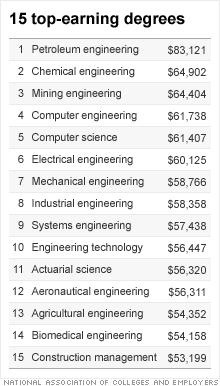
The top 15 highest-earning college degrees all have one thing in common -- math skills. That's according to a recent survey from the National Association of Colleges and Employers, which tracks college graduates' job offers.


"Math is at the crux of who gets paid," said Ed Koc, director of research at NACE. "If you have those skills, you are an extremely valuable asset. We don't generate enough people like that in this country."
This year Rochester Institute of Technology hosted recruiters from defense-industry firms like Lockheed Martin (LMT, Fortune 500) and Northrop Grumman (NOC, Fortune 500), as well as other big companies like Microsoft (MSFT, Fortune 500) and Johnson & Johnson (JNJ, Fortune 500).
"The tech fields are what's driving salaries and offers, and the top students are faring quite well," said Emanuel Contomanolis, who runs RIT's career center.


Specifically, engineering diplomas account for 12 of the 15 the top-paying majors. NACE collects its data by surveying 200 college career centers.


Energy is the key. Petroleum engineering was by far highest-paying degree, with an average starting offer of $83,121, thanks to that resource's growing scarcity. Graduates with these degrees generally find work locating oil and gas reservoirs, or in developing ways to bring those resources to the Earth's surface.
"Exploration for new energy sources is high," Koc said. "The oil and gas industry has done relatively well the past year, even though oil prices are off right now."
Other highly-paid engineering majors include chemical engineers, who employ their skills to make everything from plastics to fuel cells and have an average starting offer of $64,902.
Mining engineers start at $64,404 on average, while computer engineers, who have an expertise in both coding and electrical engineering, pocket roughly $61,738 their first year out of school.


Left behind. Of course, not every student with an engineering degree will score a fat paycheck. RIT's Contomanolis noted that "average" graduates are feeling the pinch of fewer job offers. Still, in a tough job market, graduates with technology degrees have an advantage.
"It's a tech-driven world, and demand [for engineers] is only going to grow," said Farnoosh Torabi, employment expert and Quicken blog editor. "You can't say that about many fields, especially in a recession."
Perhaps that's why more and more college students are picking their majors based on a field's earning power, ultimately "choosing a major that pays," Torabi said.


Top non-engineering fields. Only three of the 15 top paying degrees were outside the field of engineering -- but they each still require math skills.
For computer science majors, who specialize in programming and software, the average salary was $61,407. Graduates with degrees in actuarial science took home about $56,320; and jobs for students in construction management paid about $53,199. Each of these fields has paid well throughout the years, Koc said.


What happened to well-rounded? There are far fewer people graduating with math-based majors, compared to their liberal-arts counterparts, which is why they are paid at such a premium. The fields of engineering and computer science each make up about 4% of all college graduates, while social science and history each comprise 16%, Koc noted.


As a result, salaries for graduates who studied fields like social work command tiny paychecks, somewhere in the vicinity of $29,000. English, foreign language and communications majors make about $35,000, Koc said.
"It's a supply and demand issue," he added. "So few grads offer math skills, and those who can are rewarded."


Read more...

Student loans turn into crushing burden for unwary borrowers

11:24 AM Reporter: Flyer Goodness 0 Responses
Some who think they are getting a federal loan find out later that they hold a private loan. The difference can be costly.

By Kathy M. Kristof
December 27, 2008

Natalie Hickey left her small hometown in Ohio six years ago and aimed her beat-up Dodge Intrepid for the West Coast. Four years later, she realized a long-held dream and graduated with a bachelor's degree in photography from Brooks Institute in Santa Barbara.
She also picked up $140,000 in student debt, some of it at interest rates as high as 18%. Her monthly payments are roughly $1,700, more than her rent and car payment combined. 

"I don't have all this debt because I was buying stuff," said Hickey, who now lives in Texas. "I was just trying to pay tuition, living on ramen noodles and doing everything as cheaply as I could."
Hickey got caught in an increasingly common trap in the nation's $85-billion student loan market. She borrowed heavily, presuming that all her debt was part of the federal student loan program.
But most of the money she borrowed was actually in private loans, the fastest-growing segment of the student loan market. Private loans have no relation to the federal loan program, with one exception: In many cases, they are offered by the same for-profit companies that provide federally funded student loans.

As a result, some students who think they are getting a federal loan find out later that they hold a private loan. The difference can be costly.
Whereas federally guaranteed loans have fixed interest rates, currently either 6% or 6.8%, private loans are more like credit card debt. Interest rates aren't fixed and often run 15% or more, not counting fees.
Most students have little experience in taking out loans, yet the federal government doesn't require lenders to disclose the total cost of a student loan and other terms upfront -- before signing -- as it does for car loans and mortgages.

"Students are in the cross hairs, being bombarded by very sophisticated and, to some extent, ethically marginal lenders," said Rep. George Miller (D-Martinez), who sponsored legislation passed this year that will require lenders to provide more disclosures on fees. "My fear is that we are developing a predatory market, just like we have had in mortgages."

Read more...

Jobless College Grad Wants Tuition Back From Alma Mater

11:17 AM Reporter: Flyer Goodness 0 Responses
August 04, 2009
By Jeff Greer
via US News

Having trouble getting that first job out of school? Blame your college—and sue it while you're at it. That's what a recent college graduate is doing.

Trina Thompson, a 27-year-old graduate of Monroe College in the Bronx, N.Y., is suing her alma mater for $70,000 in tuition money, the Associated Press reports. Since her graduation with an information technology degree in April, Thompson has not been able to find work. And Thompson says the school hasn't helped in the job-searching process, either.

"They have not tried enough to help me," Thompson wrote in her lawsuit.
Monroe College spokesman Gary Axelbank told the New York Post that the lawsuit is "completely without merit."

"The college prides itself on the excellent career-development support that we provide to each of our students, and this case does not deserve further consideration," Axelbank told the Post.
Searching for a college? Get our America's Best Colleges 2010 complete rankings.

Read more...

Advice for Young, Jobless College Graduates

11:09 AM Reporter: Flyer Goodness 0 Responses
By Dominick Tao


For many recent college graduates, graduation may have been the last sure thing they knew about their budding careers. Stepping off the stage, degrees conferred, they emerged from colleges and universities into one of the worst job markets since the Great Depression.

And that uncertainty takes its toll.

There’s the anxiety that comes from being educated and jobless. There’s the guilt from taking financial subsidies from already struggling parents. And then there’s the worry of not being able to pay many thousands of dollars in student loans.

Like other ailments of the ego, sometimes, group therapy helps assuage the condition.

At a forum hosted by the Century Foundation, a policy research organization, in Manhattan on Wednesday, the sum of these fears was embodied by the audience — mostly summer interns and recent college graduates — as they took advice from a panel of experts assembled to explain reasons and solutions for their post-graduate employment pain.

On the panel were a writer, a policy analyst, an economist and the leader of a youth advocacy group.

At first, it seemed as though nothing but waves of gloom were rolling off the panel.

“There is $684 billion in unpaid student loans,” said the writer, Anya Kamenetz, author of “Generation Debt: The New Economics of Being Young.”

The policy analyst, Edwin W. Koc of the National Association of Colleges and Employers, said in his research, he was searching for bright spots in the employment picture for young professionals.

“Basically,” he said, “We didn’t find any.”

The economist, William M. Rodgers III of Rutgers University, shared an anecdote on how he and his wife landed tenure-track jobs in the same department. “We were able to use her network,” he said.

And Matthew Segal, a 2008 graduate of Kenyon College and the executive director of the Student Association for Voter Empowerment, asked for all the unpaid interns in the room to raise their hands. Half the audience gave a signal, and shared a nervous laugh of camaraderie.

Toward the back of the room, Tufts University student Sara Mishra, an unpaid intern working in New York this summer, muttered something to a friend seated next to her.

“All I’m getting from this is depressing,” she said. “But, oh well.”

Later, she explained: “To be fair, that’s what it is. They’re just telling us the facts.”

But the panelists at the forum, titled “Out of College and Out of Work: Good Employment Policy for a Bad Economy,” did their best to make light of the seemingly endless string of bad news and rejection letters facing the current cohort of recent graduates.

Ms. Kamenetz pointed out that compared to many other groups of people, college graduates, even if their dream jobs need to be deferred for a year or so, are one of the best-placed groups to weather an economic meltdown.

Few need to worry about supporting families, or paying for mortgages on drastically devalued homes. Their 401(k)’s didn’t take much of a hit, since most college students didn’t have one to begin with. And compared to other young people who skipped college entirely, unemployment rates for degree-holders is more than half that of their less educated peers.

“Education is the greatest hedge against joblessness,” Mr. Rodgers said.

And the fact that the forum took place to begin with is a sign that young people are not taking their gloomy job prospects laying down. The event was the brainchild of Julia Mellon, a 19-year-old junior at Washington University, who is an intern at the Century Foundation this summer.

“A topic like youth unemployment that hits close to home motivates my generation to be active in politics,” Ms. Mellon said.


via NY Times Citiblog


Read more...

Graduate school for unemployed college students

10:05 AM Reporter: Flyer Goodness 0 Responses
By Seth Godin

Fewer college grads have jobs than at any other time in recent memory—a report by the National Association of Colleges and Employers annual student survey said that 20 percent of 2009 college graduates who applied for a job actually have one. So, what should the unfortunate 80% do?

How about a post-graduate year doing some combination of the following (not just one, how about all):

* Spend twenty hours a week running a project for a non-profit.
* Teach yourself Java, HTML, Flash, PHP and SQL. Not a little, but mastery. [Clarification: I know you can't become a master programmer of all these in a year. I used the word mastery to distinguish it from 'familiarity' which is what you get from one of those Dummies type books. I would hope you could write code that solves problems, works and is reasonably clear, not that you can program well enough to work for Joel Spolsky. Sorry if I ruffled feathers.]
* Volunteer to coach or assistant coach a kids sports team.
* Start, run and grow an online community.
* Give a speech a week to local organizations.
* Write a regular newsletter or blog about an industry you care about.
* Learn a foreign language fluently.
* Write three detailed business plans for projects in the industry you care about.
* Self-publish a book.
* Run a marathon.

Beats law school.

If you wake up every morning at 6, give up TV and treat this list like a job, you'll have no trouble accomplishing everything on it. Everything! When you do, what happens to your job prospects?


http://sethgodin.typepad.com/seths_blog/2009/06/graduate-school-for-unemployed-college-students.html

Read more...

10 Ways To Make the Most of Moving Back Home

11:24 AM Reporter: Flyer Goodness 0 Responses
So for the first time after years of independence and freedom, you feel like you're rewinding the clock back to high school by moving into the same old room at your parent's house. Sure there's the tiny perks: no rent (sometimes), free food (most of the time), and free laundering (haven't heard of otherwise...so far). But the point is, we're moving backwards, by making the move BACK home. No doubt about it: You start off at home in high school, you're off in college, and you're SUPPOSED to be off on your own after that, right? It used to be that only the failures and lazies crawled back home to mommy and daddy, but national statistics claim somewhere between 70-80% of graduates have moved back home.

But things don't need to be miserable and fruitless. Here's some ways to maximize your time while you're back, and how to put yourself on the right track to get on your own ASAP.


1. Put yourself on the Clock. 
Schedule your days, keeping an itinerary for weekdays at the very least. Set tasks and errands as appointments instead of just walking through your daily activities.


2. Maintain a Work-Like Environment.
Keep your door closed, especially if your housemates, parents or relatives are very inclusive, imposing or inviting.  Try to do this during business hours at least -- your job is to stay busy and get work for yourself, so this time should definitely be for yourself.


3. Get Ready For Work.
You're going to get work sometime in the future, so you might as well get used to how that will be in the morning. Get up before 8, wash up, and get dressed up like you're going into the office. This is a tip that has also been working like a charm for telecommuters as well.


4. Have your own Office.
Have a separate space, or a room, where you can focus and do your work -- even if it's just job searching, emails, or balancing your checkbook -- its good to have an area where you ONLY work to get your subconscious in the right mode.


5. Work in a Social Environment.
If possible, spend a few hours a day working in public spaces to get used to working with outside and social distractions. Try your local Starbucks, Barnes & Noble, Library, or anyplace that offers free seating.  Unless you plan on doing specific types of freelancing for the rest of your life, odds are high that you'll be working in an environment outside your house.


6. Start Something.
Get in touch with people back home and think of a project that you can work together with friends or acquaintances still there -- whether it's a website, a car, a blog, a machine, a book, or a competition. It's good to keep up the habit of collaboration and teamwork even if you're not employed.  If you're having a hard time finding collaborators, pick an industry, or even a hobby, and set up a blog dedicated to a specific interest you have about it.


7. Use Your Parents.

If you're back at home, exploit the obvious network opportunity: your parents. Meet with their friends, coworkers, neighbors -- you never know who they might know, and the people that they do will probably not only be older, but employed. 


8. Meet Old People.
Don't just go through your parents and family to pursue the older, more employed demographic.  Check out the incredible networking opportunities through neighborhood, religious, nonprofit and political groups as well.  Many of these individuals can be right outside your door or just down the street: retired CEO's, mothers of HR executives, and grandfathers of of start-up founders.


9. Go Beyond Craigslist.
Don't be the Governator in Total Recall and physically pursue opportunities.  Visit your local markets and shops to stay updated with the classifieds section of your city newspapers and magazines -- you can even try writing for them.  Register and follow up with staffing agencies, big and small, in your area -- spend a few minutes to just walk in and check out whats going on, agencies can be just blocks away from your house.


10. Work Out.
If you find that you still have extra time to relax, have fun or idle, get in shape. Not only will it be beneficial to your performance, but it'll keep you goal motivated and results oriented. Plus, you'll be able to use local gyms, clubs, teams and organizations as a fantastic network.

Read more...

Changing the World

12:17 PM Reporter: Flyer Goodness 0 Responses
By BOB HERBERT

Here at home, the terrible toll from the worst economic downturn since the Great Depression continues, with no end to the joblessness in sight and no comprehensible plans for fashioning a healthy economy for the years ahead. The government’s finances resemble a Ponzi scheme. If you want to see the epidemic that is really clobbering American families, look past the H1N1 virus to the home foreclosure crisis.

The Times ran a Page A1 article on Monday that said layoffs, foreclosures and other problems associated with the recession had resulted in big increases in the number of runaway children, many of whom were living in dangerous conditions in the streets.

Americans have tended to watch with a remarkable (I think frightening) degree of passivity as crises of all sorts have gripped the country and sent millions of lives into tailspins. Where people once might have deluged their elected representatives with complaints, joined unions, resisted mass firings, confronted their employers with serious demands, marched for social justice and created brand new civic organizations to fight for the things they believed in, the tendency now is to assume that there is little or nothing ordinary individuals can do about the conditions that plague them.

This is so wrong. It is the kind of thinking that would have stopped the civil rights movement in its tracks, that would have kept women in the kitchen or the steno pool, that would have prevented labor unions from forcing open the doors that led to the creation of a vast middle class.

This passivity and sense of helplessness most likely stems from the refusal of so many Americans over the past few decades to acknowledge any sense of personal responsibility for the policies and choices that have led the country into such a dismal state of affairs, and to turn their backs on any real obligation to help others who were struggling.

Those chickens have come home to roost. Being an American has become a spectator sport. Most Americans watch the news the way you’d watch a ballgame, or a long-running television series, believing that they have no more control over important real-life events than a viewer would have over a coach’s strategy or a script for “Law & Order.”

http://www.nytimes.com/2009/10/27/opinion/27herbert.html?_r=1

Read more...