You're Doing It Wrong
Statistics show which job-hunting techniques are the most fruitful, and which ones can waste the biggest time. Odds are, you're doing the latter...
Write With Us
We're looking for Editors and Contributors to join YJ. See how you can keep your CV recent and get your writing published by emailing us.
More Grads Back at Home
In case moving back with Mom and Pop was the most financially viable option for you, know that you're not alone. You're actually in a majority ranging from 70 to 80 percent...
The "Lost Generation?"
The media has been calling graduated 20-somethings horrible names, and most recently Businessweek has been laughing at us. Well, we're sick of it...

Most lucrative college degrees

11:37 AM Reporter: Flyer Goodness 0 Responses
Hint: Grab a pencil, calculator, protractor ... or a drill. Engineering majors snag most of the top spots.

July 24, 2009


NEW YORK (CNNMoney.com) -- Math majors don't always get much respect on college campuses, but fat post-grad wallets should be enough to give them a boost.
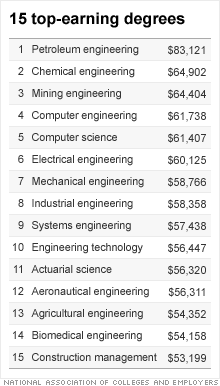
The top 15 highest-earning college degrees all have one thing in common -- math skills. That's according to a recent survey from the National Association of Colleges and Employers, which tracks college graduates' job offers.


"Math is at the crux of who gets paid," said Ed Koc, director of research at NACE. "If you have those skills, you are an extremely valuable asset. We don't generate enough people like that in this country."
This year Rochester Institute of Technology hosted recruiters from defense-industry firms like Lockheed Martin (LMT, Fortune 500) and Northrop Grumman (NOC, Fortune 500), as well as other big companies like Microsoft (MSFT, Fortune 500) and Johnson & Johnson (JNJ, Fortune 500).
"The tech fields are what's driving salaries and offers, and the top students are faring quite well," said Emanuel Contomanolis, who runs RIT's career center.


Specifically, engineering diplomas account for 12 of the 15 the top-paying majors. NACE collects its data by surveying 200 college career centers.


Energy is the key. Petroleum engineering was by far highest-paying degree, with an average starting offer of $83,121, thanks to that resource's growing scarcity. Graduates with these degrees generally find work locating oil and gas reservoirs, or in developing ways to bring those resources to the Earth's surface.
"Exploration for new energy sources is high," Koc said. "The oil and gas industry has done relatively well the past year, even though oil prices are off right now."
Other highly-paid engineering majors include chemical engineers, who employ their skills to make everything from plastics to fuel cells and have an average starting offer of $64,902.
Mining engineers start at $64,404 on average, while computer engineers, who have an expertise in both coding and electrical engineering, pocket roughly $61,738 their first year out of school.


Left behind. Of course, not every student with an engineering degree will score a fat paycheck. RIT's Contomanolis noted that "average" graduates are feeling the pinch of fewer job offers. Still, in a tough job market, graduates with technology degrees have an advantage.
"It's a tech-driven world, and demand [for engineers] is only going to grow," said Farnoosh Torabi, employment expert and Quicken blog editor. "You can't say that about many fields, especially in a recession."
Perhaps that's why more and more college students are picking their majors based on a field's earning power, ultimately "choosing a major that pays," Torabi said.


Top non-engineering fields. Only three of the 15 top paying degrees were outside the field of engineering -- but they each still require math skills.
For computer science majors, who specialize in programming and software, the average salary was $61,407. Graduates with degrees in actuarial science took home about $56,320; and jobs for students in construction management paid about $53,199. Each of these fields has paid well throughout the years, Koc said.


What happened to well-rounded? There are far fewer people graduating with math-based majors, compared to their liberal-arts counterparts, which is why they are paid at such a premium. The fields of engineering and computer science each make up about 4% of all college graduates, while social science and history each comprise 16%, Koc noted.


As a result, salaries for graduates who studied fields like social work command tiny paychecks, somewhere in the vicinity of $29,000. English, foreign language and communications majors make about $35,000, Koc said.
"It's a supply and demand issue," he added. "So few grads offer math skills, and those who can are rewarded."


Read more...

Student loans turn into crushing burden for unwary borrowers

11:24 AM Reporter: Flyer Goodness 0 Responses
Some who think they are getting a federal loan find out later that they hold a private loan. The difference can be costly.

By Kathy M. Kristof
December 27, 2008

Natalie Hickey left her small hometown in Ohio six years ago and aimed her beat-up Dodge Intrepid for the West Coast. Four years later, she realized a long-held dream and graduated with a bachelor's degree in photography from Brooks Institute in Santa Barbara.
She also picked up $140,000 in student debt, some of it at interest rates as high as 18%. Her monthly payments are roughly $1,700, more than her rent and car payment combined. 

"I don't have all this debt because I was buying stuff," said Hickey, who now lives in Texas. "I was just trying to pay tuition, living on ramen noodles and doing everything as cheaply as I could."
Hickey got caught in an increasingly common trap in the nation's $85-billion student loan market. She borrowed heavily, presuming that all her debt was part of the federal student loan program.
But most of the money she borrowed was actually in private loans, the fastest-growing segment of the student loan market. Private loans have no relation to the federal loan program, with one exception: In many cases, they are offered by the same for-profit companies that provide federally funded student loans.

As a result, some students who think they are getting a federal loan find out later that they hold a private loan. The difference can be costly.
Whereas federally guaranteed loans have fixed interest rates, currently either 6% or 6.8%, private loans are more like credit card debt. Interest rates aren't fixed and often run 15% or more, not counting fees.
Most students have little experience in taking out loans, yet the federal government doesn't require lenders to disclose the total cost of a student loan and other terms upfront -- before signing -- as it does for car loans and mortgages.

"Students are in the cross hairs, being bombarded by very sophisticated and, to some extent, ethically marginal lenders," said Rep. George Miller (D-Martinez), who sponsored legislation passed this year that will require lenders to provide more disclosures on fees. "My fear is that we are developing a predatory market, just like we have had in mortgages."

Read more...

Jobless College Grad Wants Tuition Back From Alma Mater

11:17 AM Reporter: Flyer Goodness 0 Responses
August 04, 2009
By Jeff Greer
via US News

Having trouble getting that first job out of school? Blame your college—and sue it while you're at it. That's what a recent college graduate is doing.

Trina Thompson, a 27-year-old graduate of Monroe College in the Bronx, N.Y., is suing her alma mater for $70,000 in tuition money, the Associated Press reports. Since her graduation with an information technology degree in April, Thompson has not been able to find work. And Thompson says the school hasn't helped in the job-searching process, either.

"They have not tried enough to help me," Thompson wrote in her lawsuit.
Monroe College spokesman Gary Axelbank told the New York Post that the lawsuit is "completely without merit."

"The college prides itself on the excellent career-development support that we provide to each of our students, and this case does not deserve further consideration," Axelbank told the Post.
Searching for a college? Get our America's Best Colleges 2010 complete rankings.

Read more...

Advice for Young, Jobless College Graduates

11:09 AM Reporter: Flyer Goodness 0 Responses
By Dominick Tao


For many recent college graduates, graduation may have been the last sure thing they knew about their budding careers. Stepping off the stage, degrees conferred, they emerged from colleges and universities into one of the worst job markets since the Great Depression.

And that uncertainty takes its toll.

There’s the anxiety that comes from being educated and jobless. There’s the guilt from taking financial subsidies from already struggling parents. And then there’s the worry of not being able to pay many thousands of dollars in student loans.

Like other ailments of the ego, sometimes, group therapy helps assuage the condition.

At a forum hosted by the Century Foundation, a policy research organization, in Manhattan on Wednesday, the sum of these fears was embodied by the audience — mostly summer interns and recent college graduates — as they took advice from a panel of experts assembled to explain reasons and solutions for their post-graduate employment pain.

On the panel were a writer, a policy analyst, an economist and the leader of a youth advocacy group.

At first, it seemed as though nothing but waves of gloom were rolling off the panel.

“There is $684 billion in unpaid student loans,” said the writer, Anya Kamenetz, author of “Generation Debt: The New Economics of Being Young.”

The policy analyst, Edwin W. Koc of the National Association of Colleges and Employers, said in his research, he was searching for bright spots in the employment picture for young professionals.

“Basically,” he said, “We didn’t find any.”

The economist, William M. Rodgers III of Rutgers University, shared an anecdote on how he and his wife landed tenure-track jobs in the same department. “We were able to use her network,” he said.

And Matthew Segal, a 2008 graduate of Kenyon College and the executive director of the Student Association for Voter Empowerment, asked for all the unpaid interns in the room to raise their hands. Half the audience gave a signal, and shared a nervous laugh of camaraderie.

Toward the back of the room, Tufts University student Sara Mishra, an unpaid intern working in New York this summer, muttered something to a friend seated next to her.

“All I’m getting from this is depressing,” she said. “But, oh well.”

Later, she explained: “To be fair, that’s what it is. They’re just telling us the facts.”

But the panelists at the forum, titled “Out of College and Out of Work: Good Employment Policy for a Bad Economy,” did their best to make light of the seemingly endless string of bad news and rejection letters facing the current cohort of recent graduates.

Ms. Kamenetz pointed out that compared to many other groups of people, college graduates, even if their dream jobs need to be deferred for a year or so, are one of the best-placed groups to weather an economic meltdown.

Few need to worry about supporting families, or paying for mortgages on drastically devalued homes. Their 401(k)’s didn’t take much of a hit, since most college students didn’t have one to begin with. And compared to other young people who skipped college entirely, unemployment rates for degree-holders is more than half that of their less educated peers.

“Education is the greatest hedge against joblessness,” Mr. Rodgers said.

And the fact that the forum took place to begin with is a sign that young people are not taking their gloomy job prospects laying down. The event was the brainchild of Julia Mellon, a 19-year-old junior at Washington University, who is an intern at the Century Foundation this summer.

“A topic like youth unemployment that hits close to home motivates my generation to be active in politics,” Ms. Mellon said.


via NY Times Citiblog


Read more...

Graduate school for unemployed college students

10:05 AM Reporter: Flyer Goodness 0 Responses
By Seth Godin

Fewer college grads have jobs than at any other time in recent memory—a report by the National Association of Colleges and Employers annual student survey said that 20 percent of 2009 college graduates who applied for a job actually have one. So, what should the unfortunate 80% do?

How about a post-graduate year doing some combination of the following (not just one, how about all):

* Spend twenty hours a week running a project for a non-profit.
* Teach yourself Java, HTML, Flash, PHP and SQL. Not a little, but mastery. [Clarification: I know you can't become a master programmer of all these in a year. I used the word mastery to distinguish it from 'familiarity' which is what you get from one of those Dummies type books. I would hope you could write code that solves problems, works and is reasonably clear, not that you can program well enough to work for Joel Spolsky. Sorry if I ruffled feathers.]
* Volunteer to coach or assistant coach a kids sports team.
* Start, run and grow an online community.
* Give a speech a week to local organizations.
* Write a regular newsletter or blog about an industry you care about.
* Learn a foreign language fluently.
* Write three detailed business plans for projects in the industry you care about.
* Self-publish a book.
* Run a marathon.

Beats law school.

If you wake up every morning at 6, give up TV and treat this list like a job, you'll have no trouble accomplishing everything on it. Everything! When you do, what happens to your job prospects?


http://sethgodin.typepad.com/seths_blog/2009/06/graduate-school-for-unemployed-college-students.html

Read more...

10 Ways To Make the Most of Moving Back Home

11:24 AM Reporter: Flyer Goodness 0 Responses
So for the first time after years of independence and freedom, you feel like you're rewinding the clock back to high school by moving into the same old room at your parent's house. Sure there's the tiny perks: no rent (sometimes), free food (most of the time), and free laundering (haven't heard of otherwise...so far). But the point is, we're moving backwards, by making the move BACK home. No doubt about it: You start off at home in high school, you're off in college, and you're SUPPOSED to be off on your own after that, right? It used to be that only the failures and lazies crawled back home to mommy and daddy, but national statistics claim somewhere between 70-80% of graduates have moved back home.

But things don't need to be miserable and fruitless. Here's some ways to maximize your time while you're back, and how to put yourself on the right track to get on your own ASAP.


1. Put yourself on the Clock. 
Schedule your days, keeping an itinerary for weekdays at the very least. Set tasks and errands as appointments instead of just walking through your daily activities.


2. Maintain a Work-Like Environment.
Keep your door closed, especially if your housemates, parents or relatives are very inclusive, imposing or inviting.  Try to do this during business hours at least -- your job is to stay busy and get work for yourself, so this time should definitely be for yourself.


3. Get Ready For Work.
You're going to get work sometime in the future, so you might as well get used to how that will be in the morning. Get up before 8, wash up, and get dressed up like you're going into the office. This is a tip that has also been working like a charm for telecommuters as well.


4. Have your own Office.
Have a separate space, or a room, where you can focus and do your work -- even if it's just job searching, emails, or balancing your checkbook -- its good to have an area where you ONLY work to get your subconscious in the right mode.


5. Work in a Social Environment.
If possible, spend a few hours a day working in public spaces to get used to working with outside and social distractions. Try your local Starbucks, Barnes & Noble, Library, or anyplace that offers free seating.  Unless you plan on doing specific types of freelancing for the rest of your life, odds are high that you'll be working in an environment outside your house.


6. Start Something.
Get in touch with people back home and think of a project that you can work together with friends or acquaintances still there -- whether it's a website, a car, a blog, a machine, a book, or a competition. It's good to keep up the habit of collaboration and teamwork even if you're not employed.  If you're having a hard time finding collaborators, pick an industry, or even a hobby, and set up a blog dedicated to a specific interest you have about it.


7. Use Your Parents.

If you're back at home, exploit the obvious network opportunity: your parents. Meet with their friends, coworkers, neighbors -- you never know who they might know, and the people that they do will probably not only be older, but employed. 


8. Meet Old People.
Don't just go through your parents and family to pursue the older, more employed demographic.  Check out the incredible networking opportunities through neighborhood, religious, nonprofit and political groups as well.  Many of these individuals can be right outside your door or just down the street: retired CEO's, mothers of HR executives, and grandfathers of of start-up founders.


9. Go Beyond Craigslist.
Don't be the Governator in Total Recall and physically pursue opportunities.  Visit your local markets and shops to stay updated with the classifieds section of your city newspapers and magazines -- you can even try writing for them.  Register and follow up with staffing agencies, big and small, in your area -- spend a few minutes to just walk in and check out whats going on, agencies can be just blocks away from your house.


10. Work Out.
If you find that you still have extra time to relax, have fun or idle, get in shape. Not only will it be beneficial to your performance, but it'll keep you goal motivated and results oriented. Plus, you'll be able to use local gyms, clubs, teams and organizations as a fantastic network.

Read more...

Changing the World

12:17 PM Reporter: Flyer Goodness 0 Responses
By BOB HERBERT

Here at home, the terrible toll from the worst economic downturn since the Great Depression continues, with no end to the joblessness in sight and no comprehensible plans for fashioning a healthy economy for the years ahead. The government’s finances resemble a Ponzi scheme. If you want to see the epidemic that is really clobbering American families, look past the H1N1 virus to the home foreclosure crisis.

The Times ran a Page A1 article on Monday that said layoffs, foreclosures and other problems associated with the recession had resulted in big increases in the number of runaway children, many of whom were living in dangerous conditions in the streets.

Americans have tended to watch with a remarkable (I think frightening) degree of passivity as crises of all sorts have gripped the country and sent millions of lives into tailspins. Where people once might have deluged their elected representatives with complaints, joined unions, resisted mass firings, confronted their employers with serious demands, marched for social justice and created brand new civic organizations to fight for the things they believed in, the tendency now is to assume that there is little or nothing ordinary individuals can do about the conditions that plague them.

This is so wrong. It is the kind of thinking that would have stopped the civil rights movement in its tracks, that would have kept women in the kitchen or the steno pool, that would have prevented labor unions from forcing open the doors that led to the creation of a vast middle class.

This passivity and sense of helplessness most likely stems from the refusal of so many Americans over the past few decades to acknowledge any sense of personal responsibility for the policies and choices that have led the country into such a dismal state of affairs, and to turn their backs on any real obligation to help others who were struggling.

Those chickens have come home to roost. Being an American has become a spectator sport. Most Americans watch the news the way you’d watch a ballgame, or a long-running television series, believing that they have no more control over important real-life events than a viewer would have over a coach’s strategy or a script for “Law & Order.”

http://www.nytimes.com/2009/10/27/opinion/27herbert.html?_r=1

Read more...

Constraining America's Brightest

12:07 PM Reporter: Flyer Goodness 0 Responses
By BOB HERBERT

That period right after college graduation is when young people tend to think they can set the world on fire. Careers are starting, and relationships in the broader world are forming. It's exciting, and optimism is off the charts.

So the gloomy outlook that this economy is offering so many of America's brightest young people is not just disconcerting, it's a cultural shift, a harbinger. "Attention," as the wife of a fictional salesman once said, "must be paid."

Maggie Mertens graduated in May from Smith College, where she was an editor of the student newspaper. She applied for "tons" of jobs and internships, probably 50 or more. "I was totally unemployed all summer," she said. She eventually landed an internship at NPR in Washington, which she described as "awesome," but it is unpaid.

"I was lucky enough," she said, "to connect up with a family that let me live with them for free in exchange for watching their baby a few times a week." But there was still no money coming in. So in addition to the 40-hour-a-week internship and the baby-sitting chores, Ms. Mertens is doing part-time seasonal work at a Whole Foods store.

Welcome to the new world of employment in America as we approach the second decade of the 21st century.

Josh Riman graduated from Syracuse University in 2006. "I had a job at a great advertising agency," he said, "but was laid off in 2007. I found a job the next day, amazingly enough, and worked at this next advertising shop for about a year and a half. Then, on my birthday, the place went bankrupt. We all lost our jobs."

Since then, Mr. Riman has been doing freelance and "pro bono" work. He has been unable to find anything even reasonably secure.

As jobs become increasingly scarce, more and more college graduates are working for free, at internships, which is great for employers but something of a handicap for a young man or woman who has to pay for food or a place to live.

"The whole idea of apprenticeships is coming back into vogue, as it was 100 years ago," said John Noble, director of the Office of Career Counseling at Williams College. "Certain industries, such as the media, TV, radio and so on, have always exploited recent graduates, giving them a chance to get into a very competitive field in exchange for making them work for no - or low - pay. But now this is spreading to many other industries."

Lonnie Dunlap, who heads the career services program at Northwestern University and has been advising young people on careers since the mid-70s, said today's graduates are experiencing the worst employment market she's ever seen.

"There's a sense of huge emotional anxiety among our students," she said. The young people are not only having trouble finding work themselves; many feel a sense of obligation to parents who are struggling with job losses and home foreclosures.

"In the past two years," said Ms. Dunlap, "we have seen a huge uptick in the number of recent alums coming back for services because they still haven't found work, as well as midcareer alums who have been laid off and need our help."

Like Mr. Noble, she mentioned the growing use of interns versus paid employees and said she can see the value of such unpaid work for some recent graduates, "though, of course, not everyone can afford to do that."

Despite the expansion of the gross domestic product in the quarter that ended in September, there is no sign of the kind of recovery in employment that would be needed to bring the American economy and the economic condition of American families back to robust health. It would be nice if some of the politicians and economists so obsessed with the G.D.P. would take a moment to look out the window at what is happening with real people in the real world.

They might see Laura Ram, who graduated from Baruch College in New York in May 2007. She was laid off from a full-time job almost exactly a year ago and hasn't worked since. She's been diligent about submitting applications and showing up at job fairs and so on, but nothing has come close to panning out.

"I haven't gone on a single interview," she said, "which manages to shock just about my entire family."

These recent graduates have done everything society told them to do. They've worked hard, kept their noses clean and gotten a good education (in many cases from the nation's best schools). They are ready and anxious to work. If we're having trouble finding employment for even these kids, then we're doing something profoundly wrong.


http://mobile.nytimes.com/article;jsessionid=B376C0831194E09DE3C7C8F9F1C4E6C4.w5?a=481235&f=28&sub=Columnist

Read more...

Job market lands more grads back at home

2:47 PM Reporter: Flyer Goodness 0 Responses
http://www.sfgate.com/cgi-bin/article.cgi?file=/c/a/2009/10/20/MNS71A5LUL.DTL

They feel like failures. Disillusioned, like a runner who trips out of the starting gate.
But many college graduates who've been forced by the worst job market in decades to move back home with Mom and Dad say they also feel, to their surprise, fortunate.

Read more...

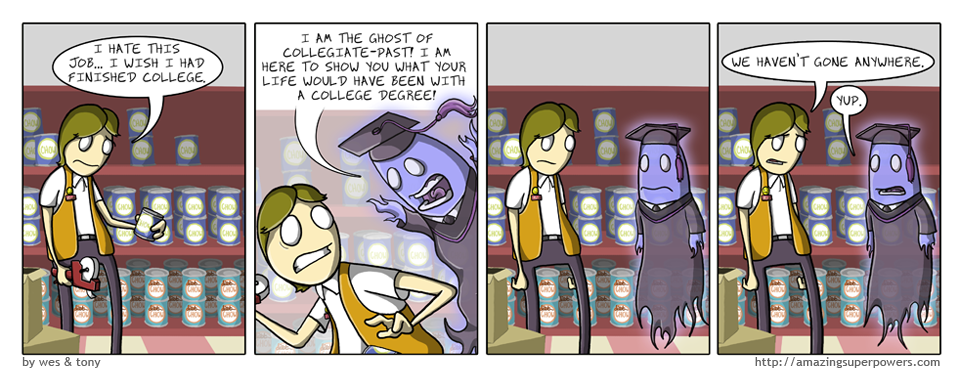
Ghost of Collegiate Past

2:45 PM Reporter: Flyer Goodness 0 Responses

http://www.amazingsuperpowers.com/2009/10/ghost-of-collegiate-past/

Read more...

Job losses in the Great Recession vs. in the Great Depression

2:44 PM Reporter: Flyer Goodness 0 Responses

http://curiouscapitalist.blogs.time.com/2009/07/02/job-losses-in-the-great-recession-vs-in-the-great-depression/

The measure of job losses in this chart is an attempt to adjust for the fact that the only good payroll employment numbers we have are for non-farm jobs, and in the 1930s a much higher percentage of Americans were still working on the farm.

To quote from an earlier post:

Read more...

The recession is over, but high unemployment remains

2:42 PM Reporter: Flyer Goodness 0 Responses
http://www.joblessandless.com/2009/09/the-recession-is-over-but-high-unemployment-remains/

The Great Recession is over. At least that’s what everyone keeps telling me. The S&P 500 gained 15.2% from April to June for its best quarter since the fourth quarter of 1998. Retail sales rose 2.7% in August. Existing home sales rose 7.2% in July from a year earlier, to a two-year high. Happy days are here again. Uncork the champagne, plate up the caviar and break out the credit cards. The spending party is about to resume? I’ll be at the As Seen On TV store if any employers want to talk to me. There’s a purple snuggie with my name on it, and the Dentist-in-a-Box will save me a little money.
Unfortunately, hiring doesn’t move lockstep with the economy; it historically lags three to six months behind. Some companies wait to see revenues return before bringing on additional staff. Others wait to know exactly what gaps in their depleted workforce need filling the most. National unemployment – currently 9.7% – is forecast to hit 10% by year’s end. There’s one thing I don’t remember from all those economics classes long ago. If consumer spending accounts for the bulk of all spending and consumers are unemployed or scared to spend, how exactly is the economy pulling out of the recession? Anybody care to explain that to me? Uncle MiltyPapa KruggyZeidy Bernanke… anyone?
I’m not even convinced that the job market will be back in any significant way. Worker productivity rose by 6.6% in the second quarter of 2009, the biggest jump since the summer of 2003. Wages remained stagnant, as they have for years. People are doing more work for the same money, and companies are reaping the benefits. Corporate profits are expected to surge; bullish estimates see 12% growth in both 2010 and 2011. That jump in productivity can be viewed as a loss of jobs. Why hire or re-hire someone to perform a task that’s already getting done? Just turn up the heat on the minions. Future innovation may lead to new types of jobs, though no one can say exactly what those jobs will be and to what extent they’ll offset recession job losses.
While things get back to normal (whatever normal will be), I have to deal with the likelihood that my unemployment will continue for some time. There are a few more jobs out there, but companies still receive hundreds of resumes for each position; the ratio of unemployed to openings is 6:1. They interview the best of the best which, given that I haven’t had an interview in a couple months, doesn’t seem to include me. I beg (as well as plead, beseech, entreat and supplicate) to differ, of course. I think I would be an invaluable employee for any company that hired me. So to date, I haven’t been willing to settle for less than I deserve. My previous salary was already on the low end for MBAs with work experience. Compromising seemed unnecessary.
That is about to change. The clock on my unemployment insurance is running down, and the end-of-the-year deadline looms large. This week I began actively seeking jobs that would be a step down. I don’t mean a big, digging in trashcans for recyclables-kind of step. The illegal aliens that roam the Jackson Heights streets with shopping carts collecting cans have that lucrative business locked up. This is a smaller step. I’m now applying for positions beneath my pay grade and skill level, even entry-level if the company is in a strong growth field. I’d be hard-pressed to turn down an offer – any offer – in online marketing, for example. The MBA will likely come off of my resume, at least one version of it. I’ve also started looking for work outside of marketing. Proofreading – one of my fallback skills – is one option. Sales is another, though I’d really prefer it not to be. We’ll see what kind of results I get in the next few weeks. As the time ticks away, I will widen my scope. That’s how desperation works.

Read more...

CIA invests in social media firm

2:29 PM Reporter: Flyer Goodness 0 Responses
http://mashable.com/2009/10/19/cia-social-media-monitoring/

If someone told you that the CIA was spying on you by way of your Twitter updates, Facebook posts, YouTube videos, or Amazon reviews, you’d probably chalk it up to a conspiracy theory.
But today we’re learning from Wired that the CIA’s technology arm In-Q-Tel has invested an undisclosed sum in Visible Technologies, a firm that provides software to companies like Microsoft for social media monitoring.

According to Wired, the investment is “part of a larger movement within the spy services to get better at using “open source intelligence” – information that’s publicly available, but often hidden.” The current plan is for the CIA to use the technology to monitor International intelligence shared in public channels to get an early edge on what’s being shared and communicated by influential voices. In addition, funds from the deal apparently will be allocated towards enhancing the foreign language monitoring capabilities of Visible Technologies .
From the report:
“Of course, such a tool can also be pointed inward, at domestic bloggers or tweeters. Visible already keeps tabs on web 2.0 sites for Dell, AT&T and Verizon. For Microsoft, the company is monitoring the buzz on its Windows 7 rollout. For Spam-maker Hormel, Visible is tracking animal-right activists’ online campaigns against the company.
“Anything that is out in the open is fair game for collection,” says Steven Aftergood, who tracks intelligence issues at the Federation of American Scientists. But “even if information is openly gathered by intelligence agencies it would still be problematic if it were used for unauthorized domestic investigations or operations. Intelligence agencies or employees might be tempted to use the tools at their disposal to compile information on political figures, critics, journalists or others, and to exploit such information for political advantage. That is not permissible even if all of the information in question is technically ‘open source.’”
While we’re not exactly thrilled by the idea of the CIA paying attention to our every tweet, we do think that it is a rather obvious next step for the intelligence agency. We can only hope they’ll use their eye on the social sphere for good.

Read more...

10 Things you need to stop twittering about

2:28 PM Reporter: Flyer Goodness 0 Responses
http://theoatmeal.com/comics/twitter_stop

Read more...

After an Interview, Being Prepared for all Outcomes

2:23 PM Reporter: Flyer Goodness 0 Responses
http://blogs.wsj.com/laidoff/2009/10/28/after-an-interview-being-prepared-for-all-outcomes/?mod=rss_wsjblog

I am writing this on the morning of the day my life may change. I am off to work for a couple of hours at my part-time contract job, and then to an interview. Two things may happen today that would have a profound effect on my life: I may find out that my contract position will become full-time and I will join the team with whom I’ve been working for the past five months. I may also be offered the position for which I am interviewing and I would have the opportunity to do something completely different from anything I’ve ever done before. Or, neither of these things will happen and nothing will change. I am becoming accustomed to this kind of uncertainty.
I am excited about the interview, but recent experience has taught me to temper that with cautious skepticism. It’s not the type of position that I would have imagined for myself. Honestly, I wouldn’t have applied for it had I seen it online, but a friend of mine just started working for the organization and has great things to say about it. It’s in a different field than my previous work, but threads of my experience weave together to point in this new direction.
Most of my bottom line requirements are there: decent salary, a company showing some growth, no recent layoffs, and a positive, energetic company culture. In this challenging economic climate, my focus has drifted to basic needs. Of course I’d love to find something with opportunities for self-actualization and changing the world, but honestly I’d be grateful right now to pay the bills and know I have a consistent place to go each morning. In the moments before the interview, this position is starting to sound really, really good.

Reality check: reserve judgment and don’t get too invested. I have to walk a fine line between my naturally high level of enthusiasm and the reality that this may not happen. I am yearning for that moment when someone finally tells me “welcome, you’re in,” but I have to protect myself from the bitter disappointment of another rejection.
And in my back pocket is the possibility with my current contract position. I have been spending several months doing this work, hoping for a permanent home.
I am not happy about this constant state of uncertainty, but have accepted it for now. It may actually make me a stronger candidate, with a more realistic perspective on the market and a higher tolerance for risk. Today, though, I settle into the safe expectation that nothing will happen and nothing will change…but secretly have high hopes.
Readers, how do you prepare for the outcome of an interview? Share your stories in the comments section.

Read more...

5 Ways Volunteering Can Save Your Job Search

2:22 PM Reporter: Flyer Goodness 0 Responses
http://www.usnews.com/money/blogs/outside-voices-careers/2009/10/21/5-ways-volunteering-can-save-your-job-search.html

You know, of course, that volunteering is good for your community. You may even know that it’s good for you personally. Research has shown that people who volunteer tend to live longer, have lower rates of depression, enjoy better physical health, have more friends, and are more self-confident.
What you may not know is that volunteering can help you get a job, too. Here are five reasons you should carve some time out of your job-hunting schedule to “work for free," along with a bonus tip:
[See 10 things to do while you're out of work.]
1. Volunteering is great for your morale. Let’s face it, a long fruitless job hunt can start to make you feel like a loser. What’s worse, potential employers can smell desperation and anger a mile away, and they are put off by it. This is why it can help to put your focus on others. Volunteering rejuvenates you and renews your sense of self-worth. Volunteering fills you up with positive feelings of accomplishment, feelings that will spread over into your job hunt.
2. Volunteering grows your network. A job hunter’s contact list can never be too long. If you’re targeting your job search to a particular company or companies (and you should be), go a step further and volunteer where employees of those companies also volunteer. Find out which foundations your target industry supports and get active in them. Or, try volunteering directly for your target company. Working together for a common goal is a great way to build strong, useful relationships with new people.
[See which resume format is best.]
3. Volunteering looks good on your résumé. Particularly if your jobless period has stretched out, it’s nice to be able to put something in that empty space. Volunteering tells potential employers that you are an energetic, compassionate person who—even when faced with problems of your own—found the wherewithal to help others. Also, consider taking on some greater responsibility in your volunteer role. Managing a fundraiser or serving on a board demonstrates leadership and puts you in a position to make higher-level contacts. (Note: If you are a new college grad, volunteering is an excellent way to beef up what might otherwise be a thin résumé.)
4. Volunteering can be a way to learn new skills, or improve the ones you already have. Whether you’re seeking to change industries or careers, or you want to move up in your field, volunteering is a great way to acquire the necessary skills. For example, if you’re a graphic designer who wants to move into PR, volunteer to not only design the logo for a local charity group but to write the copy for their brochure. Voilà, a new skill to put on your résumé.
[See how to stay positive during a long job search.]
5. Volunteering can help you choose a career. Can’t decide what you want to do? Wouldn’t it be smart to test drive a possible new career first? If you’re interested in healthcare, say, you could volunteer at a hospital or nursing home. You would find out pretty fast if this is a world where you want to spend your working life. In addition, volunteering puts you in a wonderful position to meet potential mentors and to learn about opportunities or job openings in your desired field.
A final bonus tip: While you’re volunteering (while you’re doing anything, actually!), consider the impression you're making on others. Sure, you may be “only” dishing up free meals for the homeless, but the server standing next to you may just be the CEO of a company you’d love to work for. So treat your volunteer work like a job—display a great work ethic, a good attitude, and stellar leadership skills. Do this always, and your philanthropy may just lead to a paying gig.

Read more...

"The Lost Generation?" Let's Get the $@*!# Off the Island!

10:24 AM Reporter: Flyer Goodness 0 Responses
By Michael Morgan
A recent businessweek article entitled "The Lost Generation" doesn't even want us to think there is any hope at all for employment: "In the U.S., the unemployment rate for 16- to 24-year-olds has climbed to more than 18%, from 13% a year ago. For people just starting their careers, the damage may be deep and long-lasting, potentially creating a kind of "lost generation."
Check out the writer's biography page: This guy is a 50+ history major--not a future major. We should resent the fact that he's coining a term that deprecates an entire generation that he knows nothing about. How can he? We're more tech-savvy and opportunity-rich than any generation in the history of anywhere!

Want to know an American generation better suited for the term "lost?"   We have iPhones with GPS, google Maps and Earth to get us to places we're not even supposed to go, and facebook status and twitter updates so that our friends can know exactly where to meet us for lunch ten minutes before. And you're telling us that we're lost? Why not create an iPHONE application that brings up menus from trendy restaurants all over America? Yes we can! Remember America? Or have we already forgotten.

"Only 46% of people aged 16-24 had jobs in September, the lowest since the government began counting in 1948. The crisis is even hitting recent college graduates. "I've applied for a whole lot of restaurant jobs, but even those, nobody calls me back," says Dan Schmitz, 25, a University of Wisconsin graduate with a bachelor's degree in English who lives in Brooklyn, N.Y. "Every morning I wake up thinking today's going to be the day I get a job. I've not had a job for months, and it's getting really frustrating."

The most redeeming part of the article is the explanation of how we've dug our own graves,
"Free-market economists favor removing obstacles to employment of the young, such as high minimum wages. ‘The government in some ways is contributing to this problem,’ says Kristen Lopez Eastlick, senior research analyst for the employer-backed Employment Policies Institute. She points out that the 40% hike in the federal minimum wage over the past two years made it less appealing to hire young workers. One possibility: Some U.S. states and European countries have enacted subminimum wages just for young people or people enrolled in apprenticeships."
Wasn't raising the minimum wage one of the first things you voted for if you did ever vote on a state-wide ballot? True and terrible. It should also mention our almost genetic predisposition towards procrastination. That's also helped us to destroy ourselves. College taught us to wait the night before to write a paper. It works well when "reality" lasts approximately sixteen weeks. In real life it sorts of just keeps going. Procrastination leads to burial and bones.

We can't just "get a job" anymore. You have to get an internship first. Which means you have to work free for six months--or more. Employers are able to dangle the mere possibility of real employment to add to our Facebook and Linked In profiles: another trophy next to the "top twenty school."

The article ends with a beam of sunshine blasting through the despairing clouds placed above our heads,

"The unemployment crisis among the young is not as dramatic as the financial crisis of a year ago. But it may turn out to have longer-lasting effects." Nevermind, the light of hope was the second to last sentence. The last sentence warns us of the hot coals soon to pour.
Now the unemployment crisis can be the best thing that ever happened to the "Lost Generation” because it forces us out of the spoiled complacency that we were brought up with in the 1990's: Pokemon cards and tamagatchis are a thing of the past. It makes us talk to our friends about website ideas rather than about the last "The Hills" episode; it brings us closer to our families and ourselves when we realize that no one is going to help us but ourselves and--maybe-- those who we sprung from, because we're definitely moving back in; it makes us realize that the four years of college were not worth all of the time and money we invested--it helped us socially conform, how to take advantage and ignore the availability of excessive resources, coddling support, and a wealth of other brilliant, creative thinkers who want to be known for doing something for this world just as much as you do. The only thing that makes us lost is that damn addictive J.J. Abrams' show.

Luckily there are social networking sites. So here's the deal: stop emailing whip-holders at two-hundred year old companies that see you as a piece of veal-meat: start to get back into contact with your friends from college and high school. Round them up and start a website, at least a blog; get a group of friends together who want to teach English in China, Japan, India, Turkey, Brazil, or any other country that seems appealing; and don't just get a job that you're going to hate until you can successfully pay off your student loans: figure out what you love and then figure out how to do it for the rest of your life. Don't start later, start now. Use one another! There has never been a greater time than now to work outside of the box--the lid has been blown right off. Now crawl out of your dark, obsolete expectations of success, blink at the light of day, and step out into a brave new day.


Read more...